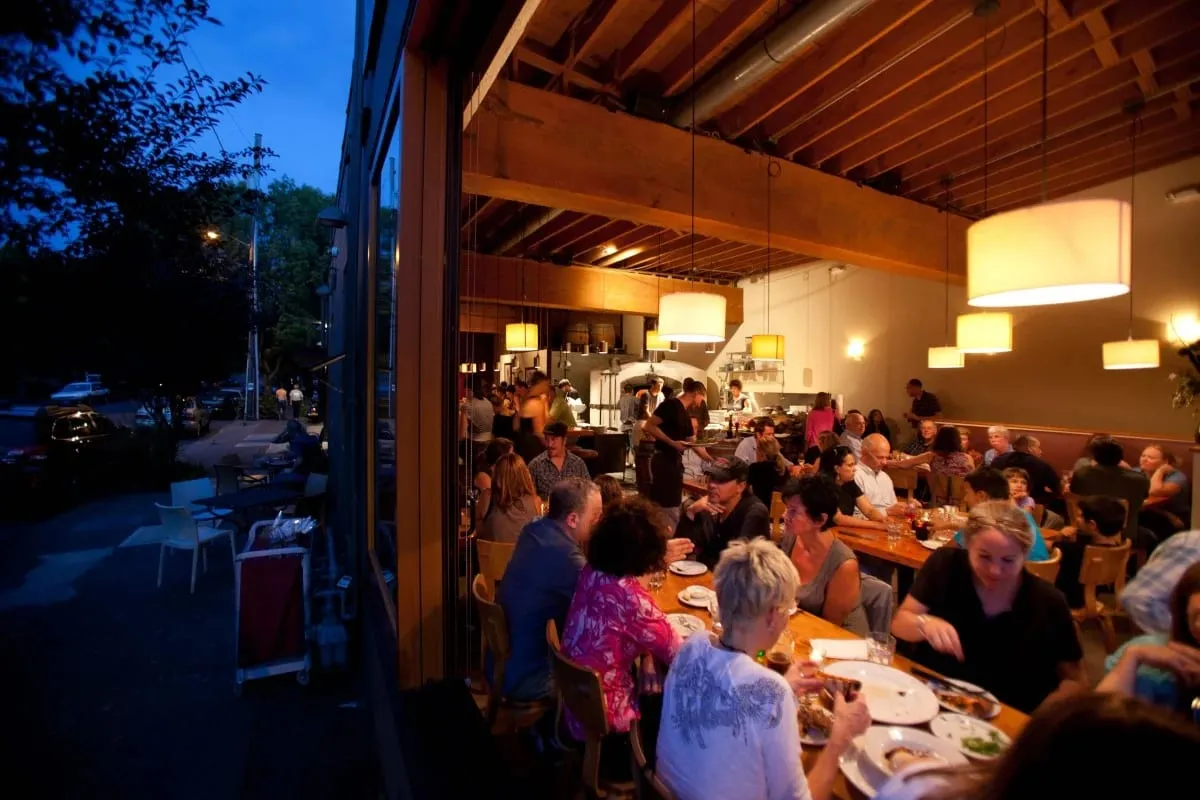
Portland takes its bread and its produce seriously. Why has that not produced a pizza of its own?
United States · 2 spots selected · last checked 2026-09-19
Portland has two well-regarded pizzerias of imported Neapolitan lineage and no indigenous form: Ken's Artisan Pizza, founded by the baker and author Ken Forkish, with a wood oven and an Oregon wine list; and Apizza Scholls, whose oversized neo-Neapolitan pies come off an electric oven. Both are personal stamps rather than a shared local grammar, and no Portland equivalent of New Haven's local pizza literature was found.
Given the city's reputation in bread and produce, the absence is itself the finding. A serious baking culture does not automatically become a pizza culture, and Portland is the clean demonstration.
One conflict is carried unresolved rather than decided: one account of Forkish's related bakery has him retiring in 2021 or 2022 with named successors, while he is still listed elsewhere as the pizzeria's owner and pizzaiolo. Nothing found settles it, so the record holds both claims rather than choosing.
Founded by baker and author Ken Forkish (Flour Water Salt Yeast; The Elements of Pizza), the SE 28th Avenue pizzeria bakes a clearly Neapolitan pizza with an American accent in a wood oven, and serves it in a room built from local salvaged materials with a wine list centred on Oregon production — an imported discipline with a locally-inflected room rather than a distinctive indigenous form.
Opened in 2005 by Brian Spangler and Kim Nyland in the Sunnyside neighborhood, Apizza Scholls has held a two-decade reputation as one of Portland's defining pizzerias, ranked among the city's best restaurants by Portland Monthly and named among America's best pizzas by Food & Wine. A named Portland Monthly critic describes the electric-oven pizzas as "neo-Neapolitan splendor" built into large, deliberately imposing pies, alongside an "East Coast classic" bacon pie — an imported discipline pushed toward an unusually large format rather than a wholly distinct local style.